Table of Contents
CAE Email Introduction
All the time students ask me “Rory, can you help me write a CAE email?”
Do you know how to effectively write a C1 Advanced: CAE email? If not, this page is for you.
A CAE Email is an optional writing task in part 2 of the C1 Advanced Cambridge English exam writing paper. It might not appear in the exam because in part 2 students answer 1 question from a choice of 3. Those 3 questions come from 5 different writing tasks.
If you can’t remember the format of the writing paper, go back to this page >>
Below you will find a video of the examiner’s assessment scale. This is what the examiners use to mark your writings. If you understand this scale and how the examiners mark, you will get a much higher score in the writing paper.
Below that, I have put a video where you learn what to do in order to write a successful CAE email. I have also written a transcript from the video!
Finally I show you some real example C1 emails. I mark them and give feedback based on the examiner’s assessment scale.
How to pass C1 Advanced Emails Video Transcript
“Hello guys,
I’m Cambridge English teacher Rory from studentlanguages.com and if you want to know how to pass part 2 of
the CAE that’s C1 advanced writing paper, emails, then keep watching this video and I will show you how to do that.
And don’t forget to watch until the end of this video because at the end I’m going to show you how you can access a C1 Advanced that’s CAE video course completely free!
So, first I want to tell you a bit about the format of this video. The first thing I’m going to do is to quickly, in less than a minute, tell you about the writing paper in the CAE exam and I am then going to drill down into my eight step strategy for successfully writing emails for this part of the exam.
So there’s going to be a lot of information in this video and I recommend taking a pen and writing notes as we go through but let’s get started straight away with the format of the writing paper.
So, in the writing paper there are two parts. Part one is an essay and in part two you have to write an answer and you have three questions and you have to choose one of them to write an answer about.
Now these three questions can be based on a variety of things including: reports, reviews, proposals, letters and also
emails. So that’s what we’re going to be focusing on in this lesson, how to write effective C1 Advanced emails.
Quick reminder this video will form part of my YouTube playlist for CAE writing. So, what I’ve done, is I’ve gone to a page on my website where I’ve recently written a post now this is in the forum of my website and if you want to contribute and speak to other students and other teachers taking the Cambridge exams then here’s a link where you can sign up and join this forum >>
Okay so it says C1 Advanced emails. The first bit is explaining a little bit of information about part 2 of the exam. So you have 90 minutes and two Tasks, so I recommend 45 minutes for one task and 45 minutes for the second task.
You need to write between 220 and 260 words.
So let’s get started.
Step number one: make sure you know how the examiners mark the exam. They use something called an examiner’s assessment scale and I made a video about this, so you should watch that because if you can understand how the examiners mark the exam, you can understand how to improve your marks and make a better answer.
Step number two: look specifically at what examiner’s want from an email. Now I’m going to go through some of these points in the next few steps for you, but if you want to watch me do a presentation on this and for all the other parts of the writing paper, I’ve actually made a CAE writing video course and I’ll put a link to that and the 90% discount in the information for you.
You can check it out if you want to but I am going to go through a lot of the information right now for you as part of my strategy.
Okay, so quick recap, step number one, make sure you know how the examiners marked the exam. Step number two, what are the examiners looking for from C1 advanced emails.
Step number three: do practice examples before the exam and time yourself. This will help you to know how long the exam lasts and there are other benefits this which you will see in the next few steps.
So how to answer C1 Advanced emails and what to write is largely dependent on the question itself, so step number four is to read the question fully and underline the main points. While you are reading the question you want to make sure you know who the target reader is. That’s really important. Who is the target reader? Who are you writing your email for? Here’s a
useful quote that I taken from the Cambridge English Advanced handbook for teachers and it says “candidates can
expect to be asked to write to for example the editor of a newspaper or magazine the director of a company to a school to a college principal or to a peer”. So, depending on who you are writing to, will impact how you write in your email and the type of language you use. So make sure you know who is the target reader then you should have an idea of what type of language you might need to use and step five is to take five minutes to plan your answer and this is why reading the question again will be really helpful because you can see whether you need to write more personal information for example, to a magazine editor or perhaps more factual information.
The target reader can help with this but so can reading the question and here’s another quote that I’ve taken from the
Cambridge English Advanced handbook for teachers which is “to reassure somebody, to correct a misunderstanding or to justify a cause of action” and these are some of the typical things you also might be asked to do in C1 Advanced emails. You
might be asked to reassure somebody, to correct a misunderstanding or to justify a course of action. So depending on which of these are asked and depending on who the target reader is, that could change your language quite a lot in an email.

Step number six is then to write your answer and this should take about 30 to 35 minutes. I recommend you should
practice with a pen or with a pencil timing yourself for 30 or 35 minutes because that is how it’s going to be in the exam. If you can simulate the exam, you will be much better prepared.
So we know to look for the target reader, we know to answer all the necessary parts of the question. Some other key points in emails are to make sure you give it an appropriate opening, perhaps ‘dear sir’ or ‘dear madam’ might be necessary and at the end maybe ‘yours sincerely’ or ‘Yours faithfully’ and your name. And if you want more detailed information about which of these to use again I have got this information in my CAE writing course. It tells you when you’re sincerely is appropriate, when yours faithfully is appropriate etc. You can even watch some free preview lessons from that course so check it CAE Writing.
So when you are writing, when you make a point, try to develop that point as much as you can because this will give you more opportunity to show your language and your grammar structures. So when you’re practising, write a point trying to develop it. Try to turn one sentence into three or four sentences. It’s also important that you show that you can link your ideas together in an appropriate way. So using linking words for example, ‘however’ and ‘but’ will be useful. But also in the way you structure your email and that is why planning your email at the beginning is important so you can create a nice flow from one paragraph to the next. So you should try to use complex language when you’re writing.
The examiner will reward you for using complex language even if you make some small mistakes, if they don’t confuse the examiner and if it’s easy to understand what you mean, you will be rewarded. So I recommend trying to use some complicated grammar structures and vocabulary etc
Step number seven is to take three to eight minutes to read over your work at the end.
Why should you do this?
You should do this mainly to check that your writing is easy to follow. Where you lose marks is when the
examiner finds it difficult to follow what you’re saying, so read over your work make sure the points are clear. Make sure there’s no areas of confusion or misunderstanding. Sometimes this can happen easily with smaller mistakes as
well as, for example with verbs if you’ve written ‘he go’ rather than ‘he goes’ for example. So make sure that your writing
is clear and that there are not many mistakes which confuse the reader in their understanding.
Finally step number eight, when you’re practising and you’re timing yourself and your writing, you should look to see whether you’ve written within the word limit in the time you’ve given yourself. Then you should look how long your
writing is on a page because you don’t want to spend time counting your words in the exam. You just want to have a good idea, okay this is how long my writing looks, so this is roughly how much I need to write in the exam.
Okay guys, so there was a lot of information in those eight steps and so what I’m going to do now is I’m very quickly going to summarise the eight steps for you.
C1 Emails – Transcript Summary
So step number one, make sure you know how the examiners mark the exam.
Step number two, make sure you know what the examiners are looking for from an email.
Step number three, do practice examples before the exam.
Step number four, at the beginning take two minutes to read the question and underline the most important parts. Watch out for the target reader, watch out for what the question is asking you to do.
Step number five, take five minutes after you’ve read the question, after you’ve underlined the important parts, five minutes to plan your answer. Think about the structure, think about what you’re asked to do, who the target
reader is.
Step number six, take 30 to 35 minutes to write your answer, develop your points properly, link your paragraphs together well. Make sure you’ve answered all the parts of the question and again are targeting the target reader and make sure you try to use a few complicated grammar or vocabulary structures.
Step number seven, take three to eight minutes to read your work at the end making sure that it’s easy to follow.
Step number eight, look how long your writing is when you’re practising, so you know how long your writing needs to be in the exam.
Okay guys so there was a lot of information there for you……”
CAE Email Sample 1
Read the sample below which a student submitted via my CAE writing assessment service and
- See if you can find any errors in the writing.
- Try to correct these errors. You can print out this page to do this, or write the errors down on a separate sheet of paper.
- Complete the examiner’s assessment scale template.
- I also completed steps (1-3) and made a video critiquing the answer 😉 watch my video below…
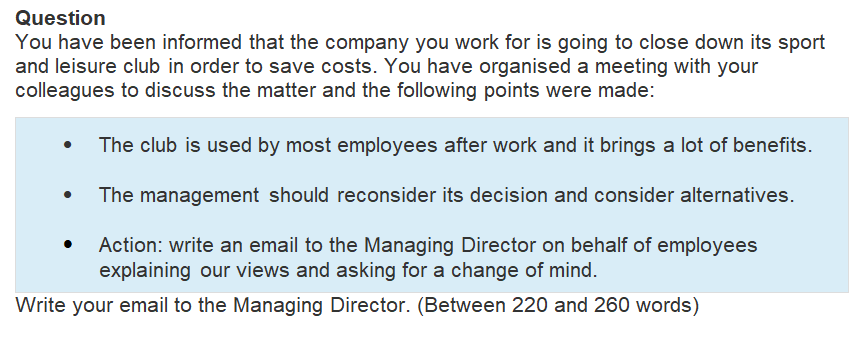
Question
The question has come from: https://www.flo-joe.co.uk/cae/students/writing/makeover/makeover6.htm
Answer
Dear Sir,
I am writing to you in connection with the recent decision from the management to close down the sports and the leisure center which I discussed with my subordinates in a meeting where they unanimously opposed the closure of the club. Therefore, they want the decision reconsidered to find some other alternatives to cost cutting.
The first reason is that many employees visit leisure club on daily basis for different physical activities as well as mental relaxation. Because, the games in the club not only keep them physically active but also they get mental relief too so employees after stressful work throughout the day get many psycho physiological benefits which directly or indirectly enhance the productivity of the company. Furthermore, a scientific research has proved that workers having no after-work leisure activities are less productive and creative compared to those engaging in such post-work physical activities.
The sales team due to pressure of achieving the target struggle much with their focus on work whereas, the table tennis, swimming in the pool require good amount of concentration which is helpful to develop focus in the sales employees. Many employees after hectic work routine want to socialize with their colleagues in an informal setting where they could share their daily challenges with one another and in my opinion, there is no better place than meeting lobby in the leisure club.
Thus, on behalf of the colleagues, I would like to request you to change the decision and find out some possible alternatives to cost saving.
I am looking forward hearing from you.
Sincerely yours,
Examiner’s Assessment Scale Template
Subscale | Mark (1-5) | Commentary |
Content | ||
Communicative Achievement | ||
Organisation | ||
Language |
CAE Email Critique
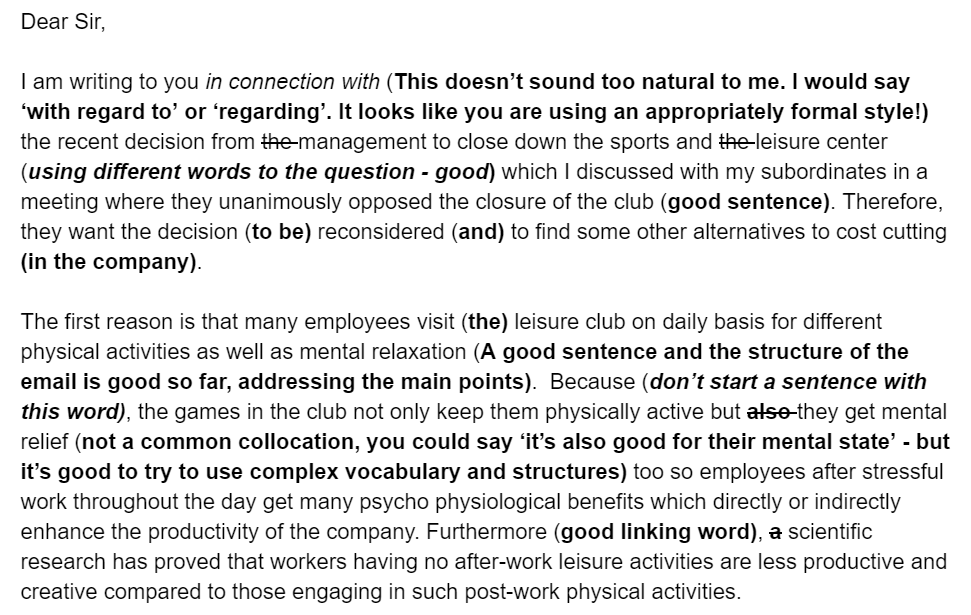
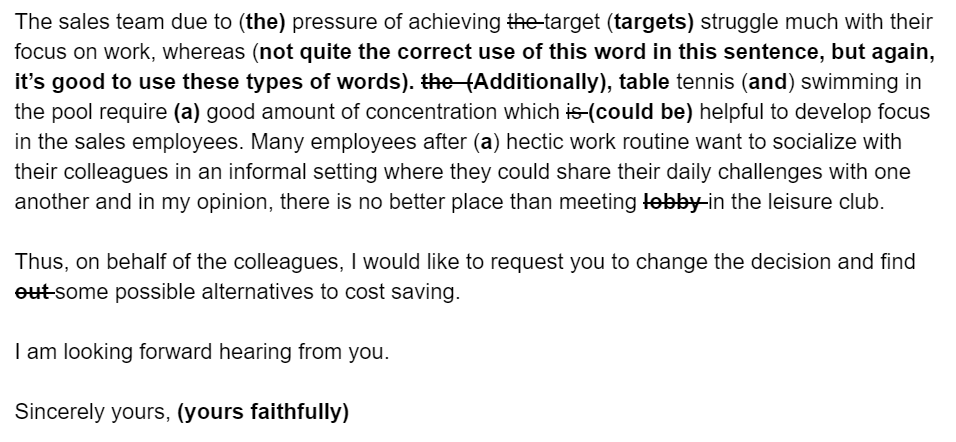
This is a good answer but I would possibly suggest a way the company could save costs. Remember to read through your work after writing. There are some language mistakes which I think you could fix yourself if you read over your work.
| Subscale | Mark | Commentary |
| Content | 4 | The candidate has answered all parts of the question. The candidate could have suggested one or two alternative methods for how the company could save costs. The target reader is fully informed. The candidate explains why it is important to keep the sports facilities and how it benefits the company. The candidate requests that management reconsider their decision. |
| Communicative Achievement | 4 | The conventions of writing an email are used. There is a clear opening paragraph and the conclusion makes the objective of the task obvious. The register is appropriate for the target reader. There is clear paragraphing which helps communicate the main ideas in an easy to follow manner. |
| Organisation | 4 | The text is well organised and coherent. Linking words and other cohesive devices are used to maintain a good flow of ideas. The main idea is clearly set out in the introduction and the reasons for this are given clearly and more concisely in the following paragraphs. The third paragraph has two main ideas. The second main idea about socialising could perhaps be given more authority and its own paragraph. |
| Language | 3 | There is a good range of simple and more complex grammatical structures used with control. There is also complex vocabulary used in this email. Although there are some mistakes, most of these are small and do not impede communication. In an email your language depends on what you are asked to do in the question and who your target reader is. You have used appropriate language in your email. |
CAE Email Pass or Fail?
Content – 4
Communicative Achievement – 4
Organisation – 4
Language – 3
Total: 15/20
In my opinion, this email is good enough to pass the second part of the writing paper. The student would need to get 9/20 for the part 1 essay in order to pass the writing paper. Find out more about calculating your CAE score here >>
CAE Email Example 2
Instructions
- Read the email question below and then read the sample answer my student wrote.
- Right click and print off the example answer if it’s easier (you should be able to save the image).
- Write down any extra mistakes you find in the writing and make any corrections you think are appropriate.
- Download the examiner’s assessment scale here and complete this.
- When you finish doing these 4 things, jump up and down with a BIG SMILE on your face – it’s a lot of work doing the 4 steps above, but believe me, doing this will drastically improve your chances of success in the exam!
Question
Your local sport and leisure club is having to shut down as the international company who operate it cannot afford to keep it running. You have organised a discussion with local residents and a few points were made:
Children frequently use the club.
The company should consider ways to keep it open and try to make it more profitable.
Action: write an email for the local residents asking the Managing Director of the company to reconsider.
Write your email to the Managing Director. (Between 220 and 260 words)
Cambridge Writing Assessment Scale
Write your critique on the assessment scale below. Download here >> or use the online template >>
Subscale | Mark (1-5) | Commentary |
Content | ||
Communicative Achievement | ||
Organisation | ||
Language |
CAE Email Sample 2 – Answer With Feedback
To: Managing Director
From: Staff Representative
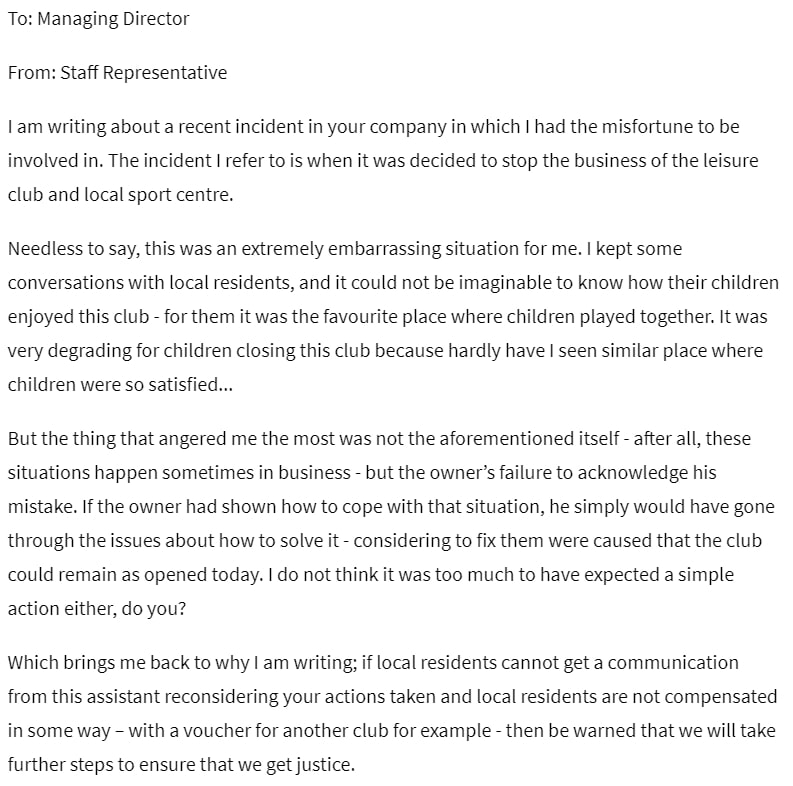
I am writing about a recent incident in your company in (don’t say ‘in’ here because you say it at the end of the sentence) which I had the misfortune to be involved in. The incident I refer to is when it was decided to stop (I think you could write this in a simpler way) the business of the leisure club and local sport centre.
Needless to say (good expression), this was an extremely embarrassing situation for me. I kept(‘had’ – we don’t ‘keep’ conversations) some conversations with local residents, and it could not be imaginable to know (it’s better to say- ‘we were not able to imagine’) how much their children enjoyed this club – for them (‘them’ is the parents or the children?) it was the favourite place where children played together. (Closing this club) It was very degrading (I think you could use a better word) for the children closing this club because hardly ever have I seen a similar place where children were so satisfied…
But the thing that angered me the most was not the aforementioned itself – (after all, these situations happen sometimes in business) (better to use ‘( )’ rather than ‘-’) – but the owner’s failure to acknowledge his mistake. If the owner had shown how to cope with that situation, he simply would have gone through the issues about how to solve it – considering to fix them were caused that the club could remain as opened today (this is too difficult to read, you should say ‘fixing the problems could have allowed the club to remain open). I do not think it was too much to have expected a simple action either, do you? (I wouldn’t ask an interrogative question like this to a Managing Director).
Which brings me back to why I am writing; if local residents cannot get a communication from this assistant reconsidering your actions taken (if local residents do not receive communication from the club’s assistant concerning your actions) and local residents are not compensated in some way – with a voucher for another club for example – then be warned that we will take further steps to ensure that we get justice.
CAE Email Sample 2 – Critique
CAE Email Sample 2 – Mark
Content = 3
Communicative Achievement = 3
Organisation = 3
Language = 2
Total = 11/20
If you got the same marks for the essay in Part 1 of the Writing exam, you would get 22/40 in total which would be a narrow fail in this paper.
You need to average 60% or more across all 5 exam papers in order to pass.
Your certificate will show you have a B2 level of English if you are close to 60%.
If you have any other questions about this part of the exam, I might have answered them here.
You can send me a writing task to mark here.
CAE Email Example 3
If you would like to see me critiquing another real CAE student’s email writing, you should watch the next video. There is some really useful guidance in the video for you as well:
Please don’t forget to subscribe to help more people find my work.
CAE Email & Other C1 Writing Samples Book
Before I show you how to write the perfect CAE email. I quickly want to tell you about an e-book I just published:
There are 3 sample emails inside as well as 18 other writings. They all have examiner style critique and you can read it for FREE with Kindle Unlimited. Check it out here >>
CAE Writing Assessment Service
Would you like me to critique one of your writings? You can complete the form on this page >>
Classroom Exercises
See this page for online exercises. Below are some exercises that you can print and your students can complete in class:
- Fill in this worksheet with information from this video.
- Read this email question.
- Write a plan for the email question here. Try to complete the plan in under 5 minutes.
- Print and read this email. Correct any mistakes you spot.
- I found some mistakes. Did you find the same ones?
- Mark and write comments about the email on this assessment scale.
- How similar is your assessment scale to mine?
Next Page >>
CAE Letter – Okay, let’s move on to look at the final part 2 CAE writing task.
CAE Writing Course
CAE Writing Test Introduction
CAE Writing Exam Format
CAE Writing Marking Criteria
C1 Advanced Essay
CAE Proposal
CAE Report
CAE Review
CAE Email
CAE Letter
CAE Exam Introduction
Next Steps
CAE Writing Samples E-book
CAE Frequently Asked Questions
CAE practice tests
Meet other members
Other useful Articles
Extra CAE Speaking Tip: Notice how I said: “let’s move on to…” in the last sentence. This is a useful phrase to use in the CAE speaking test.