Table of Contents
CAE Review
Almost every day students ask me “Rory, how can I answer the C1 Advanced: CAE Review question in the exam?” However, before answering this question. Let’s first answer another question, “what is a CAE Review?”
A CAE Review is a writing task from part 2 of the C1 Advanced (CAE) writing exam. However, reviews do not always appear in the exam. This is because in part 2 you only write one answer from three different questions which are based on 5 different writing tasks.

What are the chances of the CAE Review appearing in the exam?
CAE Writing Tip: Mathematically, there is a 3 in 5 or 60% chance that the review will appear in the exam. On top of this, ’emails’ and ‘letters’ (2 other writing tasks) won’t often appear together in the same exam. So, realistically, there is a 3 out of 4 or 75% chance of having a C1 Advanced Review question.
Confusing? Tell me about it. But I like those odds. If my maths in the paragraph above is incorrect, please write a comment at the bottom of the page! I’m an English teacher, not a Maths teacher 😉
CAE Use of English Tip: Notice how I used the word ‘incorrect’ in the paragraph above my photo? Make sure you study prefixes before the exam as you’ll probably be tested on these! They most often appear in the Use of English paper. There’s a useful page on prefixes in this book >>
Where to begin?
Often students don’t know where to begin with review writing, but luckily, you found me.
This page will lay out how to prepare for and write a review to get the examiners jumping up and down with joy.
Answering this question well, might affect whether you pass or fail the C1 Advanced exam. So make sure you follow the information on this page to ensure you get the highest marks possible!
CAE Tip: Did you see I used the phrasal verb ‘lay out‘ a couple of paragraphs ago? ‘Lay out‘ is another way to say, ‘display’ or ‘show’. Whenever you’re reading English writing, make sure you watch out for collocations and phrasal verbs like this as they are tested a lot in the exam. My recommendation is to have a little notebook and add new phrasal verbs and collocations to it every time you encounter them. If you don’t know what a collocation is, here is a quick video explaining.
Right, enough prittle prattle (informal way of saying ‘idle talk’).
Subscribe to my youtube channel 😉
When you subscribe to my youtube channel, watch, like and comment on my videos, it really helps me with the youtube algorithm. This means that my channel will grow faster and more students will find my work.
I appreciate your support so much.
I do not get paid for the work I do on this website or for making youtube videos, so hearing that I have helped you really encourages and motivates me to continue creating my work!
How to pass C1 Advanced CAE Writing Part 2 Review
Write down important notes from the video below in the relevant fields of this worksheet. You should keep this worksheet open in a separate internet tab and keep adding information to it from the rest of this page.
https://www.youtube.com/watch?v=CA3Hw_fuTSE
CAE Review Video Summary and Transcript
I hope you enjoyed the video above. Some students prefer to learn by reading rather than watching videos and so I thought it would be useful to outline the most important parts of the video for you. These are the steps you should follow if you want to pass the C1 Review writing:
Before the Exam:
- Watch and understand how examiners mark the CAE writing paper (see this video).
- Learn and remember what the examiners want from a CAE review (see ‘review advice‘ below).
- Do lots of practice examples. Use sample exam papers to help with this. If you are doing a computer based exam, make sure you write your practice answers on computer. If you are doing a paper based exam, make sure you write with a pen or pencil on a sheet of paper. When you have finished your practice answer, count how many words it is. If it is within the word limit, remember how much space it has used on the page. If you do this a few times, you will know approximately how long your writing needs to be in the exam and you do not need to waste time counting how many words you’ve written.
During the exam:
- Spend the first 2 minutes reading the question and underlining the important information and who the target reader is (see ‘review question‘ below).
- Spend 5 minutes planning your answer. Think about the type of language you will use and how you will link your key ideas together (see ‘CAE review plan‘ below).
- Take 30-35 minutes to write your answer. While writing, think about the type of language you will use (see ‘CAE review vocabulary‘ below). Examiners like to see you use complex grammatical structures and vocabulary, even if they are not executed perfectly. Make sure you answer all the required parts of the question. When you make a point, try to back it up with further information and focus on how you can link your points together nicely.
- Save 3-8 minutes to read over your work at the end. Try to read your work from an outside perspective. Make sure that the points you want to make are clear and obvious. Sometimes they are obvious to the person who wrote them, but not to a person who is reading the work for the first time. Have a look at this page for some common errors which students make at C1 Advanced.
CAE Review Advice
I would advise adding the most important bits of information from this section to your worksheet here.
https://www.cambridgeenglish.org/Images/167804-cambridge-english-advanced-handbook.pdf
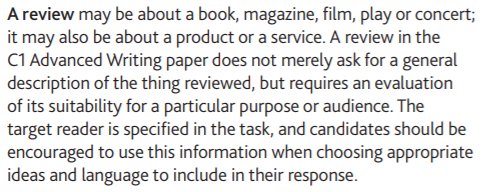
This is from a Handbook which Cambridge instruct teachers to use when preparing their students. You can learn this yourself and be in exactly the same place as a teacher. I truly believe that you can train yourself to pass the exam if you know the right resources to use and you can access this document here.
What this shows us is that you need to use descriptive language but you also need to tailor your writing to the target reader. Think about this when deciding what type of language to use (see ‘review vocabulary’ below) and whether or not your ideas are appropriate. Try to practise with review questions which target different readers. Write and Improve is a good website with a variety of questions.
https://www.cambridgeenglish.org/Images/167804-cambridge-english-advanced-handbook.pdf
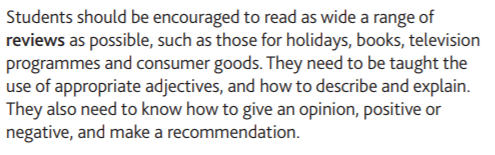
This is also good advice. When you are reading different types of reviews, try to check how the language differs from one review to another depending on the target reader. Check to see if you can find any reviews written by published or well known authors. If you find any of these reviews, check whether they give recommendations and try to copy the style of these and the language they use in your own writing.
When practising before the exam, focus on the descriptive and explanatory language you use.
CAE Review Example 1
Question

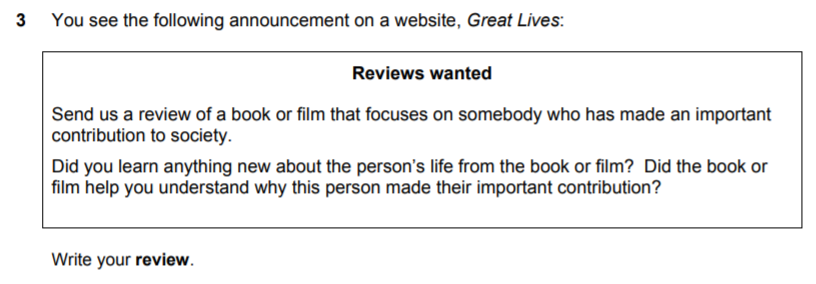
https://www.cambridgeenglish.org/images/167804-cambridge-english-advanced-handbook.pdf
These are the words I would underline from this question.
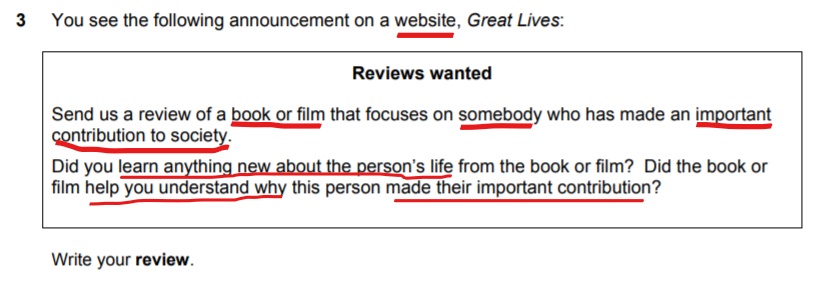
So, from the words I’ve underlined, see if you can answer these questions on a separate piece of paper:
- Who is the target reader?
- What are you reviewing.
- What are they key points you need to address?
Answers
- The target reader is a website.
- You are reviewing a book or film about a person who has made an important contribution to society.
- There are 2 key points you need to address:
1. Did you learn anything new about this person’s life?
2. Did the book or film give you a better understanding as to why this person did what they did?
CAE Review Task – Plan
So with those points in mind, I’d like you to write down a plan for this review here.
It is really important that you do this because when you’ve done that, you can compare it with my review plan below.
In the exam I would recommend trying to write a review of something real as this will be a lot easier to write about.
My CAE Review Plan
Here is a plan I made for this question. Don’t worry if yours is very different, this is just how I would write my plan to help me in the exam.
Language: neutral but engaging.
Film: The Aviator – Howard Hughes, aviation.
Format:
Introduction (60 words) –
Capture audience with a question.
State what I’m going to talk about.
First paragraph (80 words) – address point 1.
Didn’t know much about Howard Hughes before watching.
Learnt that he became very famous and had many celebrity friends.
Learnt that he suffered from mental problems.
Second paragraph (80 words) – address point 2.
He was fanatical, an adventurer/explorer with BIG dreams.
He was a perfectionist.
Extra point if needed: Was it about beating the competition? I don’t think so.
Conclusion (30 words) –
Recommendation –
A good film for a number of reasons. Although maybe just as much for personal reasons, this person made a big impact.
It goes into the psychology and you get to see depth of character.
Examiners’ Assessment Scale Template
Complete the assessment scale below based on the answer above. Print it off here, or complete an online version of this assessment scale here >>
Subscale | Mark (1-5) | Commentary |
Content | ||
Communicative Achievement | ||
Organisation | ||
Language |
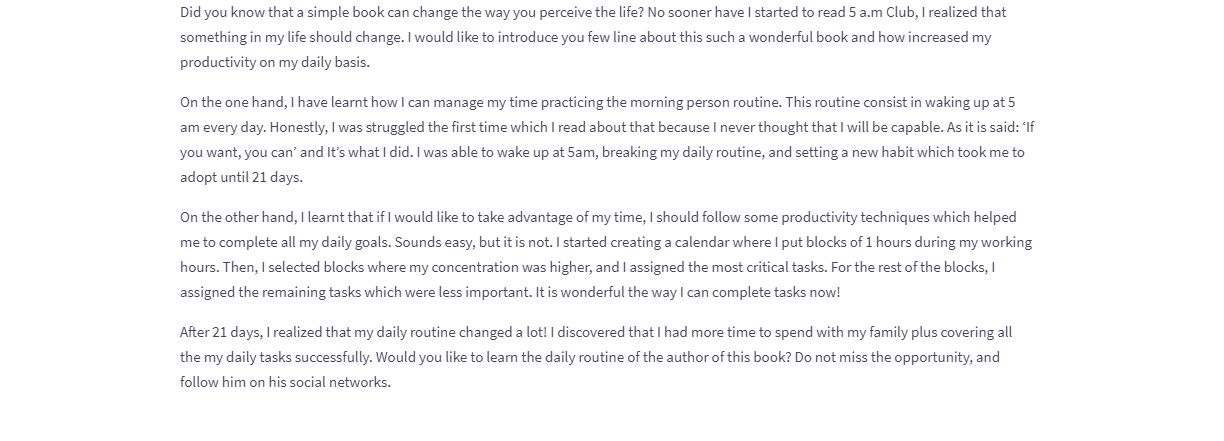
Student’s Answer With My Corrections
Did you know that a simple book can change the way you perceive (remove the word ‘the’ here because you are speaking about life in general) life? No sooner had (you should write ‘had’ here because you started reading before you ‘realised’ which was in the past) I started to read 5 a.m Club than (you need to write ‘than’ here) I realized that something in my life needed/had to (I think this should also be in the past, you read in the past then you realised your life had to change) change. I would like to introduce you few line about this (you should remove the words ‘few line about this’ and replace it with ‘to this, ‘) such a wonderful book and how it (you should repeat the subject ‘it’ here) increased my productivity on a daily basis (we normally say ‘a daily basis’ rather than ‘my daily basis’).
On the one hand, I have learnt how I can manage my time practising (you should say ‘practising’ with an ‘s’ rather than a ‘c’ here because we are using the verb form of ‘practice’ not the noun form. This is a very common mistake which students and even native English speakers make) the morning person routine. This routine consists of waking up at 5 am every day (‘consists of’ is an example of a collocation. We use lots of collocations in English. If you don’t know what a collocation is, watch this old video I made. I give lots more examples of typical C1 Advanced collocations on my website). Honestly, I (remove ‘was’) struggled the first time (remove ‘which’) I read about that because I never thought that I would be capable of doing it (you should always say capable of + verbing). As it is said: ‘If you want, you can’ and it’s what I did. I was able to wake up at 5am, breaking my daily routine, and setting a new habit which took me 21 days to adopt (you could also say ‘which took 21 days until I adopted it’. Make sure you know the difference between ‘adopt’ and ‘adapt’).
On the other hand, I learnt that if I would like to take advantage of my time, I should follow some productivity techniques which help (be careful not to jump between present and past verb tenses) me to complete all my daily goals. (It might be worth revising ‘would like to have + past participle and ‘should have + past participle). Sounds easy, but it is not. I started creating a calendar where I put blocks of 1 hours during my working hours. Then, I selected blocks where my concentration was higher, and I assigned the most critical tasks to these hours. For the rest of the blocks, I assigned the remaining tasks which were less important. It is wonderful the way I can complete tasks now!
After 21 days, I realized that my daily routine had changed a lot! (It is better to use past perfect in the last sentence because your routine changed before the realisation). I discovered that I had (had?) more time to spend with my family plus covering all the my daily tasks successfully. Would you like to learn the daily routine of the author of this book? Do not miss the opportunity, and follow him on his social networks.
This is a good attempt at the writing task. Although you have made some language related errors, you have tried to use a good range of language which you will be rewarded for in the exam.
Examiner’s Assessment Scale With My Comments
Subscale | Mark (1-5) | Commentary |
Content | 1 | This review focusses on what you learnt about your own life rather than what you learnt about the author’s life. You miss the second key point of the review which is ‘why this person made their important contribution’. If you make it more clear that you are addressing this point in your answer and if you change the main subject of the review from yourself to the author, you will get higher marks. |
Communicative Achievement | 4 | The conventions of review writing are used well. There are clear paragraphs and a strong conclusion which leaves the reader wanting to read this book. Adding a title to the review would be a good addition. The register and tone are consistent with writing a review, slightly informal with a subjective tone ‘Sounds easy, but it is not.’ You back up your statements with evidence and expand your points well. The clear paragraphing and strong introduction and conclusion help to keep the reader engaged and help with the overall flow of the review. |
Organisation | 4 | This review is well organised with clear paragraphing which help main points are clearly introduced: ‘on the one hand’, ‘on the other hand’. You introduce the broader ideas well in the introduction ‘I realised something in my life had to change’ you then get more specific talking about adopting the ‘morning person routine’ and creating blocks in your calendar. You then go back to the main idea in the conclusion that your ‘daily routine had changed a lot’. |
Language | 2 | There is a range of relevant vocabulary and this is used to communicate the ideas well. There is a good attempt at using simple and more complex grammatical structures, including less common words and phrases ‘no sooner…’. There are some errors with the language and sometimes these can hinder the flow of the writing and make it tricky for the reader to follow the passage easily. You have used good informal language, appropriate for a review, including asking the reader questions for example. You have also used good linking words and phrases to help structure your writing and add emphasis to your points ‘Honestly, I…’ There is a little confusion with some past verb tenses but these do not impede communication. |
C1 Review – Pass or Fail
Let’s add up the marks:
Content: 1/5
Communicative achievement: 4/5
Organisation: 4/5
Language: 2/5
Total: 11/20
Remember there is an examiner’s assessment criteria video above which you should watch if you have forgotten how examiners mark your writing.
This review is part 2 of the CAE writing paper. If we assume the student got 12/20 for part 1, the essay, then they would have got 22/40 in total.
This would mean the student would just fail this section of the exam by 2 marks. You need 24/40 to pass this exam paper. You can still pass the exam even if you fail one section as long as your average across all the exam papers is high enough. This page gives more detail on CAE exam marks.
CAE Review – Example 2
Question
You see this announcement on a website which is particularly popular with university students and young adults. The website is called ‘Great People’:
Review Wanted
Send us a review about a person who, in your eyes, has had a great influence on the world.
How did this person influence the world?
What can we learn from this person’s character?
Write your review in 220-260 words.
Before you read the sample answer below, you should open this sheet and write down any mistakes you find while reading the answer. You should also open this document and write your marks and comments for the sample review.
Answer
STEPHEN HAWKING:the life of a genius
World renowned physicist Stephen Hawking has died at the age of 76. The British scientist was famed for his work with black holes and relativity, and wrote several popular science books including A Brief History of Time. This scientist has also written several other books including:1.The Large Scale Structure Of Space-Time 2. A Brief History Of Time 3. Black Holes And Baby Universes And Other Essays 4. The Universe In A Nutshell 5. On The Shoulders Of Giants. The Great Works of Physics And Astronomy 6. God created the integers 7. George’s secret key to the Universe 8. George’s cosmic treasure hunt 9. George and the Big Bang 10. The Grand Design 11. My brief history. He has made many important discovers over the years, and has even been named the most influential person of the century.
Besides all of that, he was also an actor, he appeared in many movies and shows such as: Star Trek The Next Generation and The Simpsons. Sadly, no man is perfect, At the age of 22 Professor Hawking was given only a few years to live after being diagnosed with a rare form of motor neurone disease. The illness left him in a wheelchair and largely unable to speak except through a voice synthesizer.
They praised his “courage and persistence” and said his “brilliance and humour” inspired people across the world. “We will miss him forever.”
C1 Review – Mistakes & Corrections
Have a thorough read of the mistakes and corrections, followed by the examiner assessment scale below. This will help you understand how to write a C1 Advanced review.
STEPHEN HAWKING: the life of a genius
World renowned physicist Stephen Hawking has died (put this in the past simple because it’s not recent) at the age of 76. The British scientist was famed for his work with black holes and relativity, and wrote several popular science books including A Brief History of Time. This scientist has also ‘wrote’ written several other books including:1.The Large Scale Structure Of Space-Time 2. A Brief History Of Time 3. Black Holes And Baby Universes And Other Essays 4. The Universe In A Nutshell 5. On The Shoulders Of Giants. The Great Works of Physics And Astronomy 6. God created the integers 7. George’s secret key to the Universe 8. George’s cosmic treasure hunt 9. George and the Big Bang 10. The Grand Design 11. My brief history. (Don’t write so many examples in the exam. You also wouldn’t be able to research these names in the exam, but you could invent one or two names). He has made many important discover’ie’s over the years, and was has even been named the most influential person of the century.
Besides all of that, he was also an actor, he appeared in many movies and shows such as: Star Trek The Next Generation and The Simpsons. Sadly, no man is perfect (this phrase we use more when talking about somebody’s character rather than their physical disabilities), at the age of 22 Professor Hawking was given only a few years to live after being diagnosed with a rare form of motor neurone disease. The illness left him in a wheelchair and largely unable to speak except through a voice synthesizer.
They The New York Times (‘People around the world’ / ‘Academic and ordinary citizens of the world’) praised his “courage and persistence” and said his “brilliance and humour” inspired people across the world. “We will miss him forever.”
Critique
| Subscale | Mark (1-5) | Commentary |
| Content | 1 | The two main points of the question are not addressed clearly enough. The target reader is informed as to what this person did, but not specifically how he influenced the world. The target reader would also not be informed as to what can be learnt from this person’s character. The review is written in an informal register which is appropriate for this type of website.
|
| Communicative Achievement | 2 | The reader is kept relatively well engaged with the passage and phrases such as “we will miss him forever” help with this. The review could be made even more engaging by asking the reader a question. The review communicates some straightforward ideas in a relatively easy to follow manner. Some more complex ideas would be beneficial and these would perhaps come as a result of answering the two main points in the task. |
| Organisation | 2 | There is no disctinction between the introduction and the first main paragraph. The review would be better if the first paragraph was separated after ‘several other books’ and the list of books was substituted with a discussion of how Stephen Hawking influenced the world. The main ideas within the paragraphs are not developed upon. Often one idea is stated and is then followed another separate idea. For example, in the first paragraph the writer talks about Stephen Hawkins’ books and then his discoveries while in the second paragraph the writer talks about his films and then his physical condition. It is better to have one paragraph stating one main argument and for this argument to then be backed up with reasons and examples where appropriate. |
| Language | 2 | Good knowledge of the English language is evident in this writing. The writing includes some less common vocabulary, for example: ‘World renowned physicist’ ‘Courage and persistence’ The writing also includes some more complex grammatical structures, for example: ‘was given only a few years to live after being diagnosed with’. Nevertheless, there is not much language of description or explanation which are often encouraged in reviews. The ‘how’ questions which haven’t been addressed provide the perfect opportunity to use this type of language. The writer’s opinion is included in a couple of areas but this could be made stronger, including why the website should feature your review instead of somebody else’s. |
C1 Review Sample 2 – Final Marks
Content – 1
Communicative Achievement – 2
Organisation – 2
Language – 2
Total: 7/20
Unfortunately this writing would require the student to get 17/20 in part 1 to achieve the C1 level for the writing exam paper (24/40). This is not an easy task.
Learn more about what marks you need to pass here.
C1 Advanced Review Vocabulary
“Did you know…..?” – It’s good to ask a question in the review to make the reader more interested in what you’re saying.
“…I really recommend + verbing”
“I highly recommend + verbing”
“must-see” – we use this phrase when we state that somebody must watch a film or television series.
“give it a miss” – this means do not watch or read the book/film/television series.
“It will have you in hysterics” – this means when you cannot stop laughing.
“I advise you…”
“…gives a great account of…” – this means the book/film summarises or describes something very well. You can switch the word ‘great’ for a different adjective to give the phrase a different meaning.
“…gives a remarkable performance as…” – this is normally used to talk about good acting by a particular person.
“the plot was dull…” – this means the story line was boring.
“the acting…”
“the character…”
“one strength/weakness…”
Read another CAE Review Sample
- Read my CAE Writing Samples e-book. In the book you will find 21 sample writings that my students sent me. I marked the writings based on the examiner assessment scale and gave each writing my feedback and critique. Take a look now >>
Submit a Review
Send a CAE Review to me via my CAE Writing Assessment Service >>
I will mark it for you and give feedback 🙂
Classroom Activities
Check out this page for some online instructions and forms for you and your students to complete on computer.
If you prefer to print out worksheets for the classroom, the instructions below will be better for you:
- Complete this worksheet with the most important information from the video and advice above.
- Read this example review question then write a plan for it here. You should try to do this within 5 minutes.
- Print and read this example review answer. Write down any mistakes you find.
- Compare your mistakes with the ones I found here.
- Complete this assessment scale for the review.
- How similar is your assessment scale to mine?
Next Page >>
CAE Email – We’re going to look at another part 2 CAE writing task on the next page.
CAE Writing Course
CAE Writing Test Introduction
CAE Writing Exam Format
CAE Writing Marking Criteria
C1 Advanced Essay
CAE Proposal
CAE Report
CAE Review
CAE Email
CAE Letter
CAE Exam Introduction
Next Steps
CAE Writing Samples E-book
CAE Frequently Asked Questions
CAE practice tests
Meet other members
Other useful Articles